QROPS Transfer by MII Solutionz
Home About Services Process Insights FAQ MII Private Wealth Get Free Assessment
Get Free Assessment

Analysis · January 2026

How Currency Volatility Affects Your UK Pension Transfer

A deep dive into how fluctuations in the Sterling-Rupee exchange rate can shift the value of your pension by lakhs during the transfer process, and structural ways to manage this risk.

GBP-INR exchange rate charts and currency bills

The Hidden Variable in Your Pension Transfer

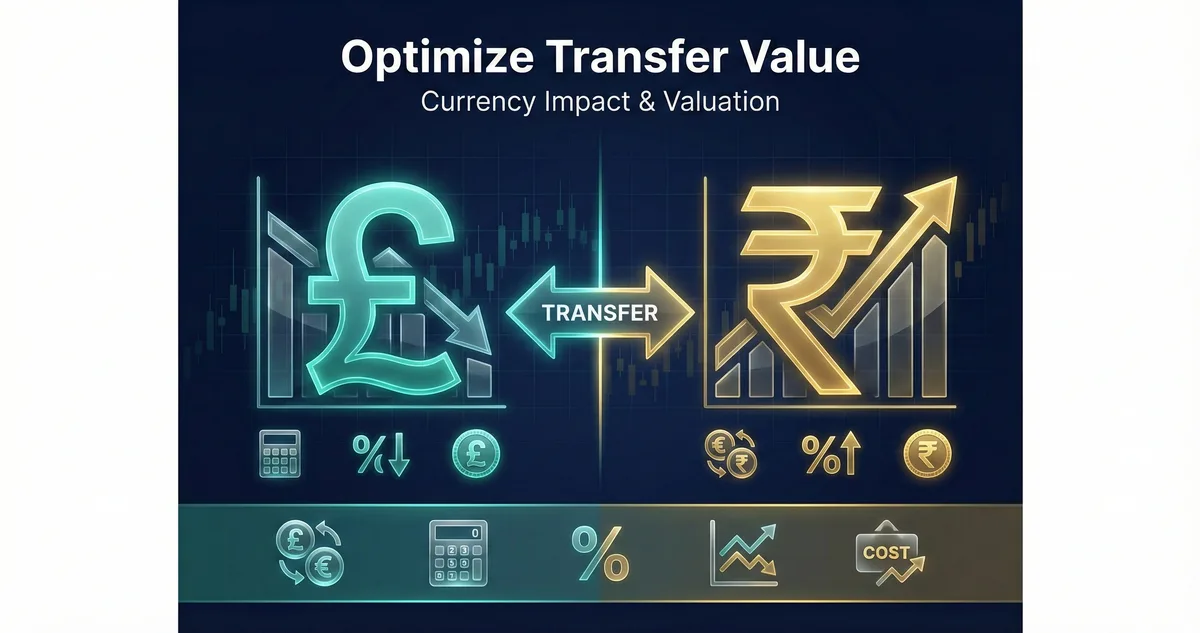
When you request a Cash Equivalent Transfer Value (CETV) from your UK pension provider, the figure they print on the document is in British Pounds Sterling (GBP). However, your ultimate expenses in India will be in Indian Rupees (INR). This introduces a significant variable: the **GBP-INR exchange rate**.

Between the day you request your transfer quote and the day the funds actually settle in India, the currency market will fluctuate. Understanding how this volatility works, and how to manage it, can save or gain you lakhs of rupees.

How a 5% Currency Swing Alters Your Pension Pot

Let us look at a practical scenario for an NRI with a pension pot valued at **£200,000**:

  • Scenario A (Strong Pound): If the transfer settles when the exchange rate is **1 GBP = 110 INR**, your pension yields **2.20 Crore INR**.
  • Scenario B (Weak Pound): If the transfer settles three weeks later after sterling slips to **1 GBP = 104 INR**, your pension yields **2.08 Crore INR**.

In this brief window, currency volatility alone has resulted in a variance of **12 Lakh Rupees**—without any change to your underlying pension portfolio in the UK. This highlights why managing exchange rates is a critical planning priority.

Guaranteed CETV Windows

Under UK pension rules, a defined-benefit (DB) pension provider must guarantee your Cash Equivalent Transfer Value (CETV) for exactly three months from the date of issue. This gives you a fixed GBP value, but your final rupee yield remains entirely dependent on the spot exchange rate at the date of settlement.

Strategic Currency Management Options

NRIs have two primary structural methods to handle GBP-INR volatility:

1. Standard Rupee QROPS (The Instant Lock-in)

In this model, your UK provider transfers sterling capital directly to the receiving Indian insurance or trust company. The Indian provider instantly converts the entire sum into INR at the prevailing wholesale spot rate on the day of receipt. This is ideal if you want absolute simplicity and want to eliminate all future sterling volatility instantly.

2. GIFT City IFSC QROPS (The Controlled Conversion)

This is the advanced wealth planning approach. By transferring your pension to an HMRC-approved QROPS located in India's GIFT City, you can keep the funds denominated in **GBP** initially. This allows you to convert the sterling assets into rupees gradually over time, executing trades when exchange rates are favorable rather than being forced into a single market rate.

Model Currency Scenarios

Request a Free Currency Stress Test

Our tools will model how historical GBP-INR fluctuations would impact your specific transfer value, comparing instant vs. phased conversion models.

Avoid the Timing Trap

The single most dangerous instinct is trying to "time" the currency market perfectly. Sterling fluctuations are highly complex, driven by macroeconomic factors like interest rates, trade balances, and geopolitical events. The safest approach is always to focus on structural alignment: if your long-term life is in India, holding your retirement wealth in INR represents a natural, risk-mitigating match. Focus on completing the transfer when your tax and residency parameters are perfect, rather than chasing a volatile exchange rate peak.

Related QROPS reading

UK Pension to GIFT City Guide

GIFT City IFSC

UK Pension to GIFT City Guide

Transferring via GIFT City IFSC.

Read article →
QROPS vs Staying in UK

Comparison

QROPS vs Staying in UK

Detailed head-to-head comparison.

Read article →